
The Roots of Water Waste
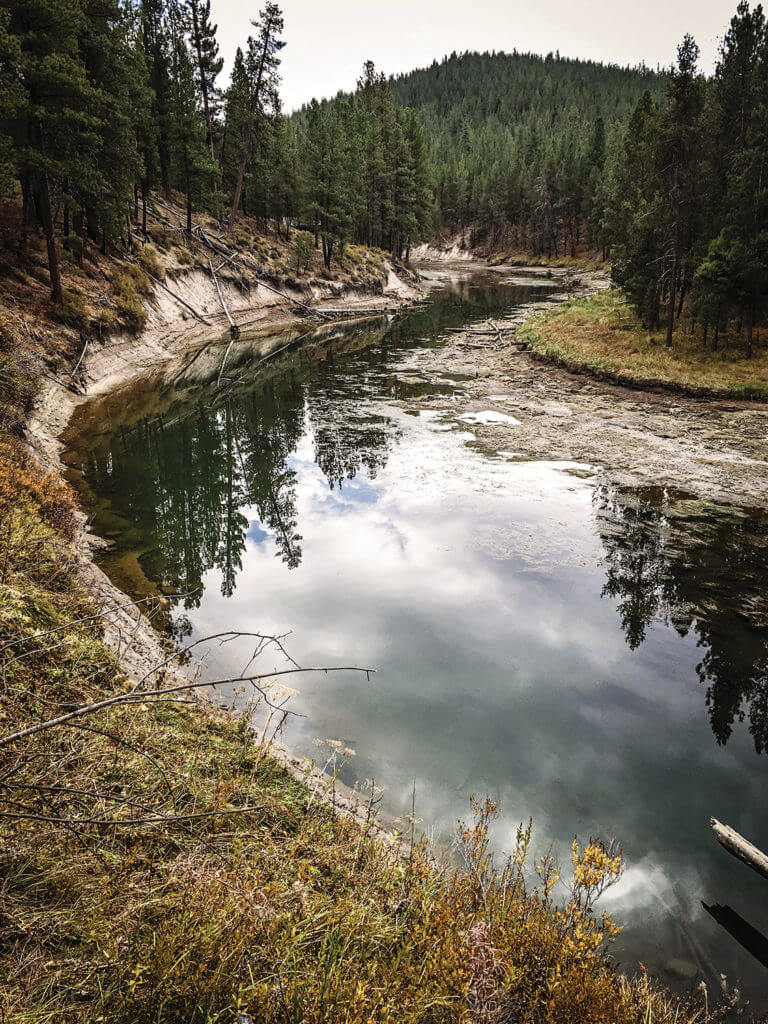
“The West is a land of limits, at least as far as water is concerned. Laws and policies that do not recognize those limits are ultimately doomed to fail.”
- Environmental Law Review (1)
Settler-colonizers arriving in Central Oregon in the late 1800s were met with a legal framework that rewarded the consumption of water instead of its conservation.
The Carey Act of 1894 furnished states with large tracts of federal desert lands to incentivize settlers and private developers to move west and "reclaim" these arid landscapes through irrigation.
Then, growing out of old mining customs, the doctrine of “prior appropriation” became the law governing new uses of water across the American West.
Three principles of prior appropriation continue to rule Western water management to this day:
First in time, first in right: The first to divert water and put it to use receives the most senior claim to the use of that water.
Use it or lose it: If you don’t use your water right within a certain time period, you may forfeit the right to use it.
Beneficial use without waste: Water must be used for a specific use that is deemed beneficial by state law and done so in a manner that is not wasteful.
In 1909, Oregon adopted the state’s first water code, enshrining prior appropriation in law and declaring that “all water within the state from all sources of water supply belongs to the public.” (2)
Within just a few years, nearly every drop of surface water in the Deschutes Basin was allocated by the State of Oregon to irrigation water rights. By 1914, almost nothing was left for native fish like steelhead and salmon, wildlife, or new consumptive uses. As a result, many Central Oregon rivers literally ran dry—and frequently did.
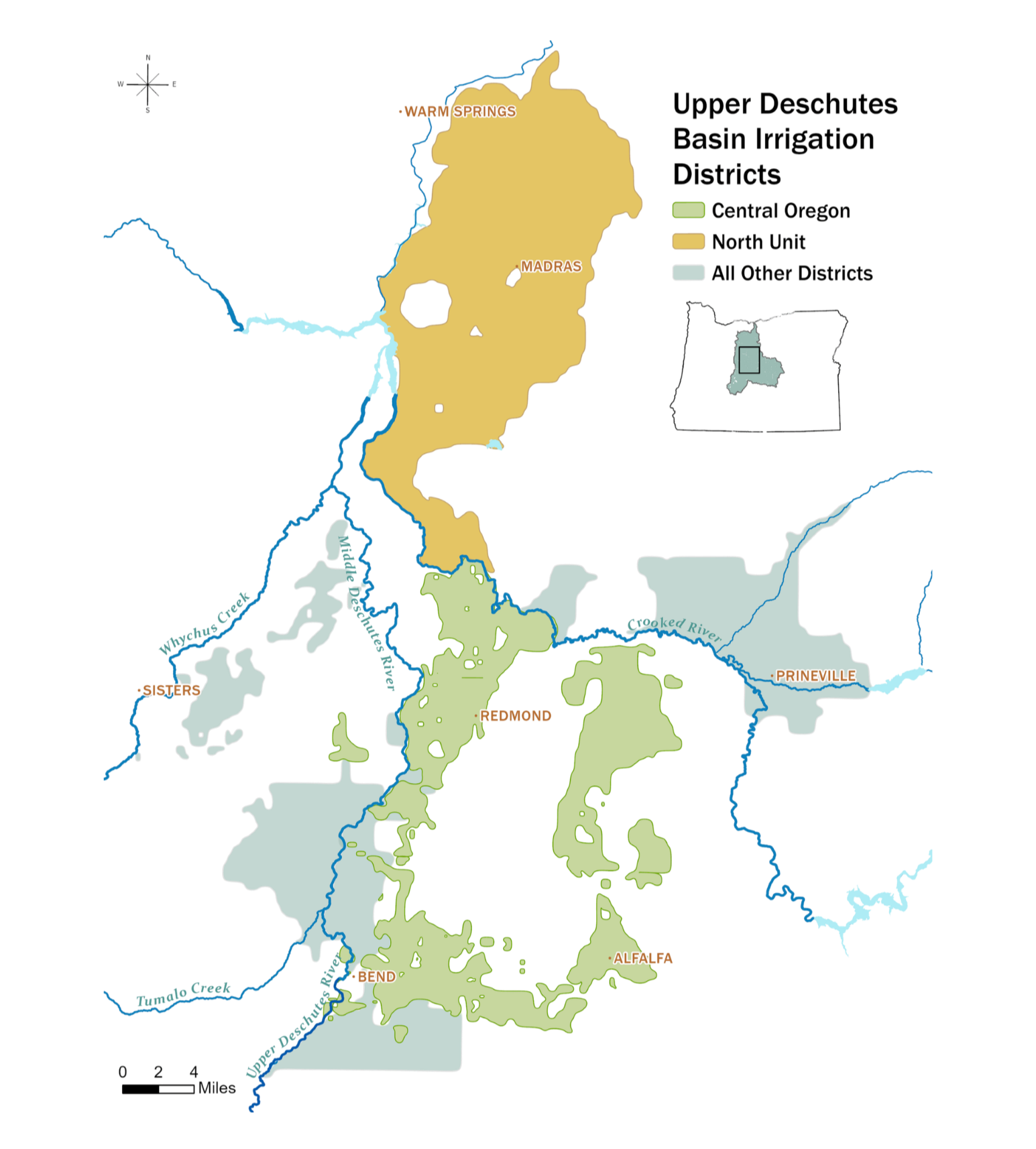
Many senior water rights became clustered around Bend in what today is known as Central Oregon Irrigation District (COID), where early settlements developed and river access was easier. Farmers that settled later in the north near Madras in what today is known as North Unit Irrigation District (NUID) were left with junior rights—leaving them last in line during times of shortage.
The first two principles of prior appropriation created strong disincentives to conserve water in irrigation districts with senior water rights, effectively penalizing districts with junior rights. And while “beneficial use without waste” sounds like a clear directive to carefully manage and efficiently utilize limited water resources, Western water law scholars have instead described this principle’s implementation as a system that has frozen in place old customs and encourages the inefficient use of water. (3)
Slipping Through the Cracks
Central Oregon’s volcanic soils create a unique network of spring-fed rivers and streams like the Metolius, Fall, and Deschutes that are driven primarily by the underlying aquifer instead of surface runoff flows typical of many other Western rivers.
But the very geology that makes the Deschutes Basin special also makes irrigation conveyance systems uniquely inefficient: roughly half of all water diverted into canals in Central Oregon is lost to seepage through the porous basalt into which canals were dug over 100 years ago. (4)
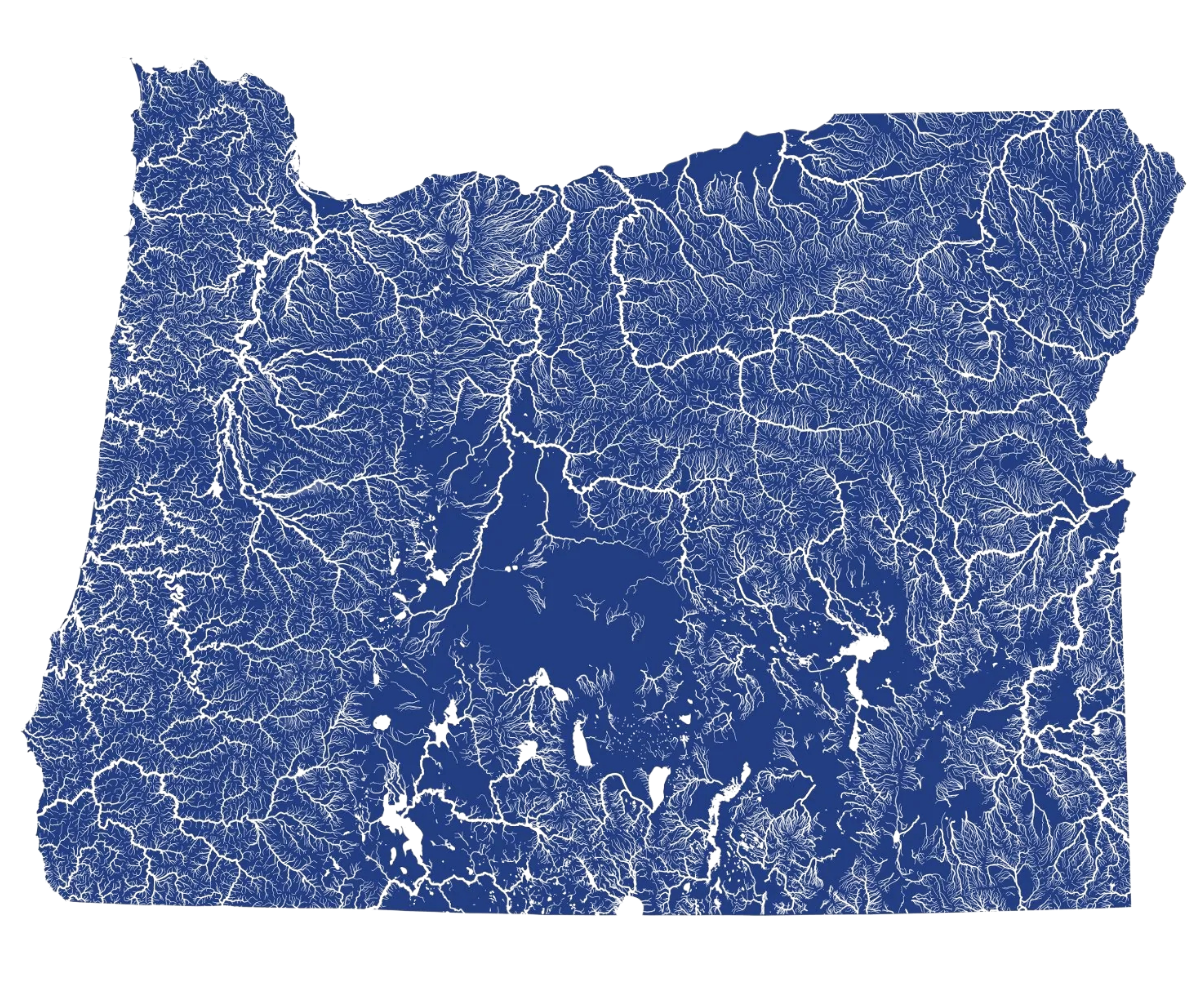
The dark center of this surface waterway map illustrates the hydrologic effect of Central Oregon’s porous volcanic geology. Map courtesy of Muir Way.
In recognition of the challenges these volcanic soils pose to agricultural diversions in the Basin, several Oregon court rulings in the 1930s allocated many regional irrigation districts additional “carry water” to compensate for the substantial transmission losses.
These decisions awarded Deschutes Basin irrigation districts some of the largest water rights in the American West. Typical Western water rights fall between 3 and 4 acre-feet per acre. By contrast, senior districts in Central Oregon like Arnold Irrigation District (AID) and COID were decreed 15.52 acre-feet per acre and 9.91 acre-feet per acre, respectively. (5)
Most crops in Central Oregon require no more than about 3 acre-feet per acre of water during any given growing season, meaning there is a staggering three- to fivefold mismatch between actual crop need and water right allocation. (6)
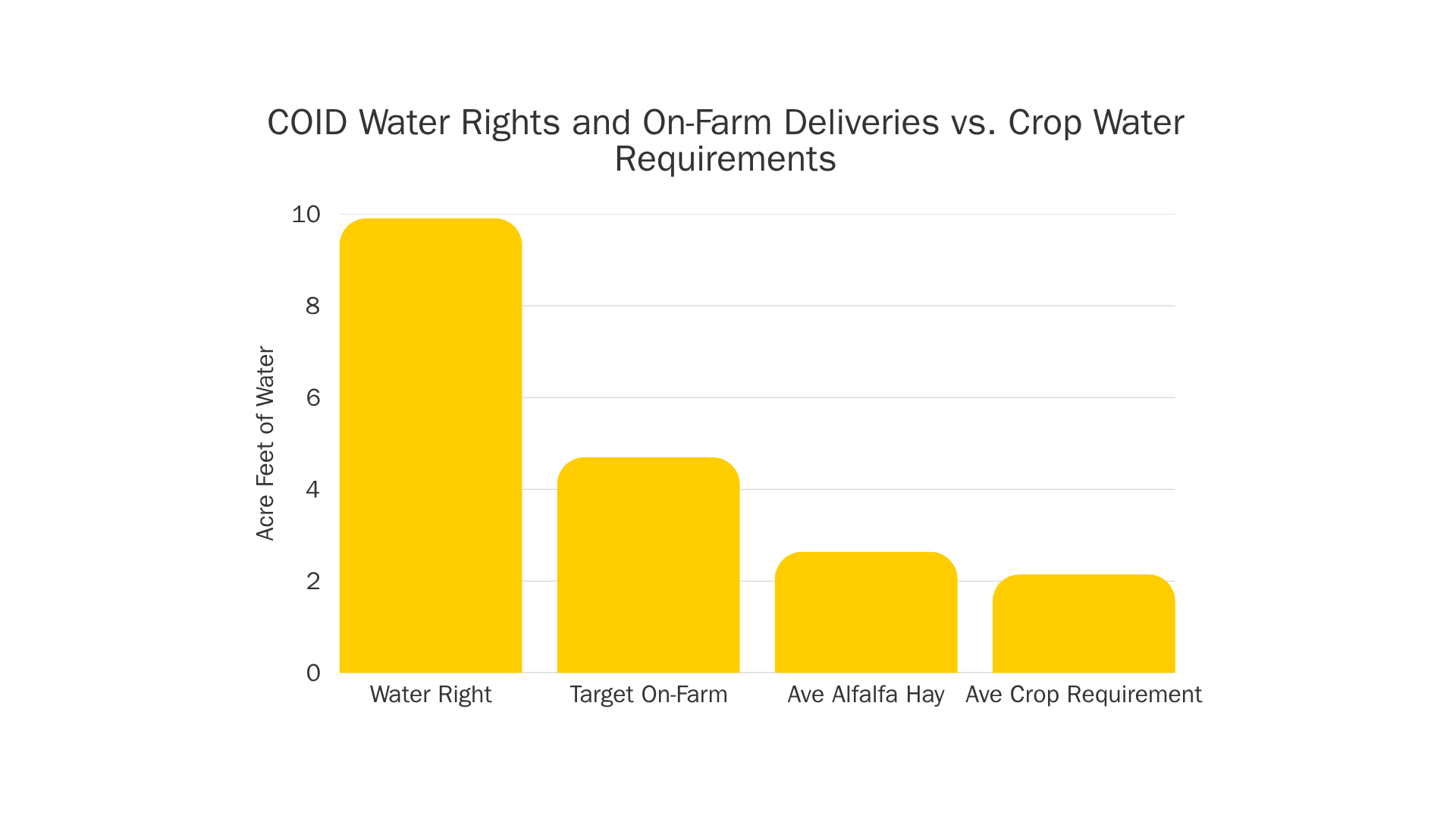
Most crops in Central Oregon—like alfalfa, the region’s most common—require around 3 acre-feet per acre or less of water during any given growing season. The average crop water requirement in the Upper Deschutes Basin is estimated to be 2.15 AF/acre (not accounting for conveyance losses or other inefficiencies). (7)
Very little data exists on how much water is actually being used by irrigators in the Deschutes Basin since most irrigation water use is not measured. However, the volume of water delivered to irrigation district patrons can be estimated based on data and information contained within numerous reports and studies on water management in the Deschutes Basin.
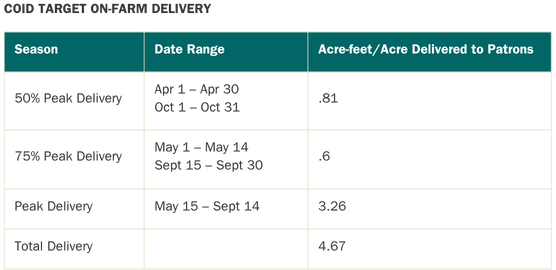
For example, COID’s current target delivery rate to its patrons is 6 gallons-per-minute (gpm). (8) Assuming a peak on-farm delivery of 6 gpm and accounting for lower volume deliveries at the beginning and end of the irrigation season, (9) COID’s target delivery volume to its patrons for the full irrigation season is approximately 4.7 acre-feet/acre.
Taking a more conservative approach and recognizing that sometimes the irrigation season starts late in April and ends early in mid-October, COID’s target delivery volume to its patrons for the full irrigation season would still be around 4.5 acre-feet/acre—roughly twice the average amount of water needed to grow crops in the Upper Deschutes Basin.
Shifting Land Use Patterns
Over the last century, Oregon’s population has grown by an average of 24 percent each decade—while Central Oregon has ballooned at a rate of 44 percent. (10) As our cities and towns have expanded to accommodate this growth, irrigated land has been steadily developed with urban levels of density. (11)
In 1901, Oregon accepted the Carey Act, which gave settlers a maximum of 160 acres of arid land if they could irrigate at least 20 acres within 10 years. By 1907, Carey Act projects in Central Oregon amounted to roughly 256,000 acres of potentially irrigated land, on top of existing farms and homesteads. Since then, properties that once averaged 160 acres have steadily shrunk, with present-day urban lot sizes often well under a quarter acre and rural residential lots closer to 10 acres.
What were previously hay fields or cattle pastures are now new subdivisions, business parks, and city parks. In many cases, these developed lands within our urban areas still retain senior water rights to the Deschutes River that are intended to irrigate rural farmlands.
And, while farming has dramatically decreased among patrons in senior districts like COID, the water is still diverted from the river as though they were engaged in productive agriculture.
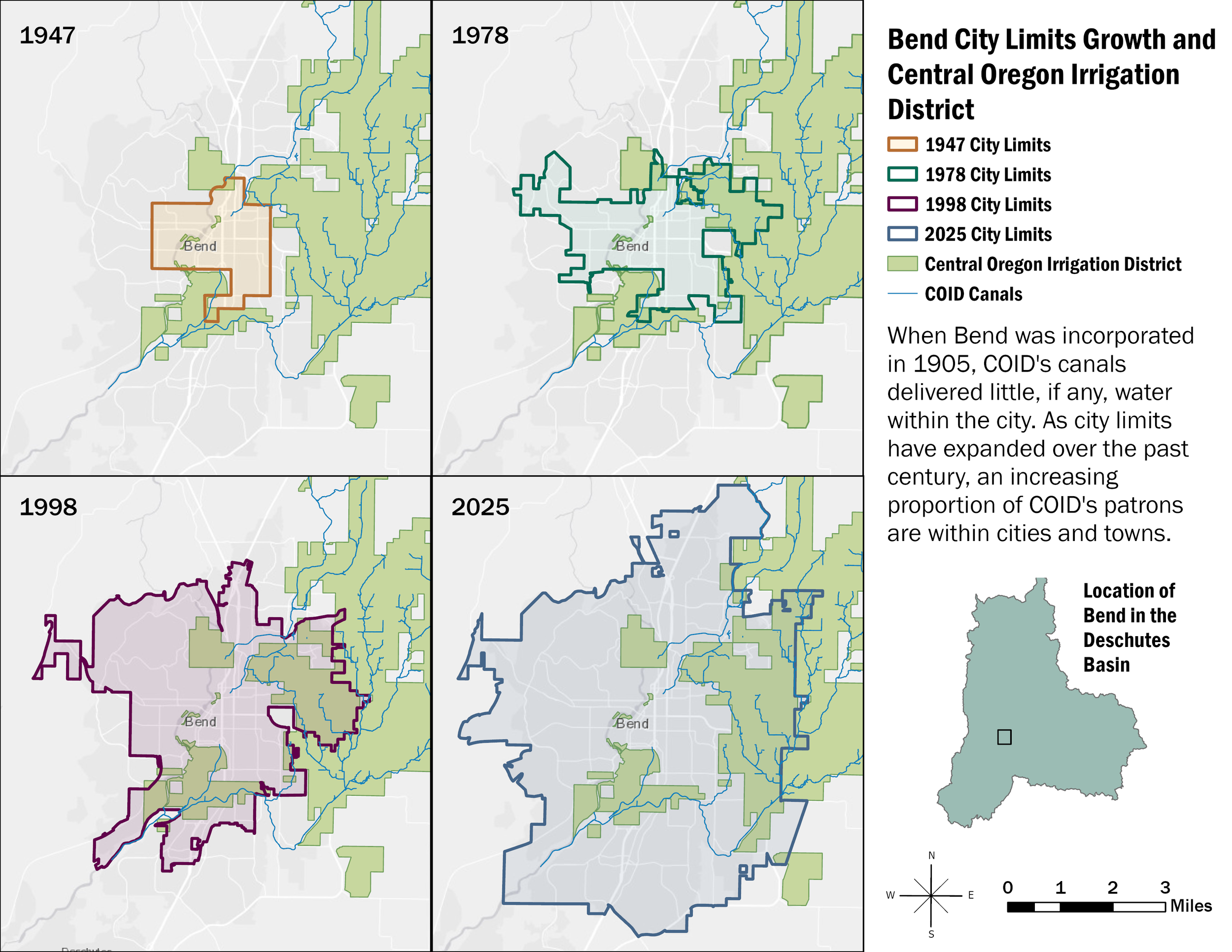
Today, a significant proportion of senior water rights holders in the Upper Deschutes Basin are simply uninterested in farming, unable to farm, or unaware their property even has an irrigation water right.
COID PATRON PERSPECTIVE: “When I found out that we had senior COID water rights for our modest house in Bend, I was pretty shocked. We know that we live in a water-scarce environment, and we know that there are junior water right holders who are trying to farm outside of our cities that don’t have enough water. That just really does not feel right—it doesn’t feel like that’s how this system should be working.”
Additionally, Deschutes County has increasingly parcelized, subdivided, and approved nonfarm development across its rural lands—leading to a rural development density that conflicts with commercial farming, which typically needs large blocks of agricultural land.
Rapid growth and development over the past several decades have also pushed up the market value of land and buildings on farmlands in Central Oregon, particularly around Bend and Redmond.
As a result, the financial benefits of owning farmland in this part of Central Oregon now far-outweigh the financial benefits of productive farm operations, (12) further incentivizing the fragmentation of once large blocks of farmland around Bend and Redmond and driving significant changes in land ownership.
This is the central contradiction: the most secure water rights are now tied to the least productive land, while ecosystems, productive agriculture, and cities are left with few options to secure water into the future.
In fact, “agricultural yield and economic value are highest on farms receiving the least amount of irrigated water” in Central Oregon. (13)
As for the patrons: senior irrigation districts still ask them to use their water even if they have no real productive use for it, simply to preserve their water rights (“use it or lose it”) and keep canals full. Patrons respond by dumping water on land with no productive intention—in some cases watering mere weeds and rocks.
In other words, an antiquated system for allocating Central Oregon’s surface water is colliding with 21st-century urbanization and county land use practices in ways that magnify waste and inequity.
SOURCES
1.) Neuman, J.C., 1998. Beneficial use, waste, and forfeiture: The inefficient search for efficiency in western water use. Environmental Law Review, 28, p.919.
2.) ORS 537.110
3.) Neuman, J.C., 1998. Beneficial use, waste, and forfeiture: The inefficient search for efficiency in western water use. Environmental Law Review, 28, p.919.
4.) In re Water Rights of Deschutes River & Its Tributaries, 148 Or 389, 36 P2d 585 (1934)
5.) In re Water Rights of Deschutes River & Its Tributaries, 148 Or 389, 36 P2d 585 (1934)
6.) Huntington et al. 2025. Crop evapotranspiration, consumptive use, and open water evaporation for Oregon. Desert Research Institute. Pub no. 41306
7.) Gannett et al. 2001. Ground-Water Hydrology of the Upper Deschutes Basin, Oregon. United States Geological Survey. Portland, Oregon.
8.) Central Oregon Irrigation District. 2021. COID Patron Handbook (See page 22, “At the present, the District is delivering six gallons per minute per acre of water right.”); Black Rock Consulting. 2017. Central Oregon Irrigation District On-Farm Water Conservation Report. Bend, OR.
9.) Black Rock Consulting. 2017. Central Oregon Irrigation District System Improvement Plan. Prepared for Central Oregon Irrigation District. Bend, Oregon.
10.) Aylward. 2006. Growth, urbanization and Land Use Change: Impacts on Agriculture and Irrigation Districts in Central Oregon.
11.) Aylward. 2006. Growth, urbanization and Land Use Change: Impacts on Agriculture and Irrigation Districts in Central Oregon.
12.) Aylward. 2006. Growth, Urbanization, and Land Use Change: Impacts on Agriculture and Irrigation Districts in Central Oregon. Bend, Oregon.
13.) Headwater Economics. 2017. Agriculture and Irrigation in Oregon’s Deschutes and Jefferson Counties. Bozeman, Montana.
MORE POSTS IN OUR WATER WASTE SERIES
