
Why So Many Roundabouts?
Bend’s Ubiquitous Traffic Circles and Their Future
By Grant Strother, Communications Associate - Summer 2026
Anyone who has driven through Bend is familiar with its uniquely abundant feature: roundabouts! The city has constructed more than 50 to date, and that number grows every year.
Fittingly, the story of the roundabout is not as straightforward as one might think.
It was private real estate developer, Brooks Resources, who first brought the concept to the Bend City Council and the public with promises of reduced congestion, greener commutes, and safer traveling. Eventually, Brooks was granted permission to construct the city’s first roundabout at Century Drive and Colorado Avenue to support new developments in the west Bend area.
Since that first roundabout was constructed in 1999, it has been a key traffic management tool as Bend’s population has grown from 50,000 then to 110,000 residents today. For drivers, roundabouts lead to an 80 percent reduction in major crashes when compared to a traditional intersection. However, for pedestrians and bicyclists, the benefits are mixed. Single-lane roundabouts are typically safer, but once roundabouts include multiple lanes, they can be more dangerous than a traditional intersection. While safety is a major concern for engineers, roundabouts have become a favorite due to their impact on traffic flow. Roundabouts typically decrease congestion by around 40 percent, reducing delays. The reduction in congestion means less idling, lowering emissions from individual vehicles. However, better traffic flow leads to more vehicles on the road, a phenomenon known as “The Fundamental Law of Road Congestion,” so any emission reductions from reduced idling are likely canceled out by the additional vehicles on the road.
A Public Art Gallery
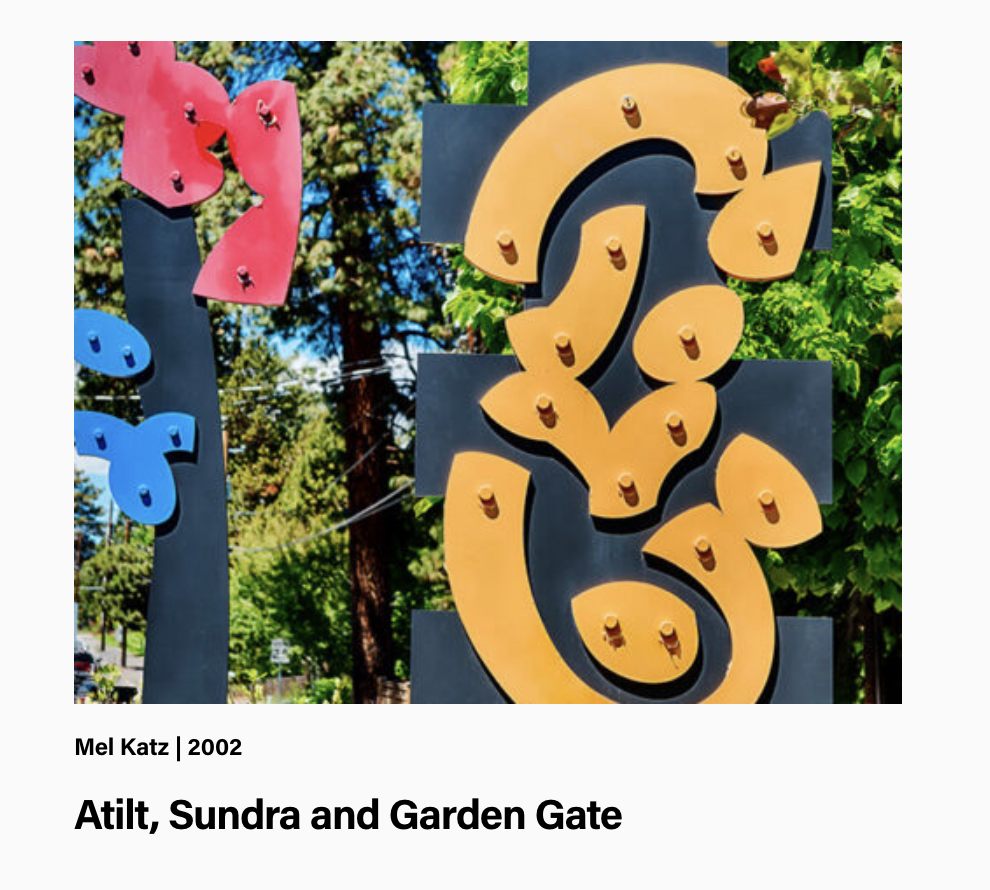
Thanks to the hard work of Art in Public Places, many of the open spaces in the middle of Bend’s roundabouts have become canvases for public art installations. Since 2001, over 25 unique sculptures have been installed throughout town. They are now a source of pride for Bendites, and Visit Bend has even created a guide for the sculptures. The sculptures span the spectrum from abstract works such as “Atilt, Sundra and Garden Gate,” by Mel Katz, installed at the intersection of 14th Street and Newport Avenue, to the realistic family of deer, “Big Ears,” by Joe Halko at 14th and Simpson Street.
With their utility proven on Century Drive, the city was quickly on board with roundabouts. In 2001, the Bend City Council adopted a Transportation Implementation Plan, which established roundabouts as the default option whenever an intersection is improved or newly constructed, unless analysis proves a roundabout to be too costly. Since they require more land than stop sign-controlled or signalized intersections, they can prove to be too costly when major land acquisition is necessary. They do, however, offer lower maintenance costs, as traffic signals can cost around $8,000 a year to run.
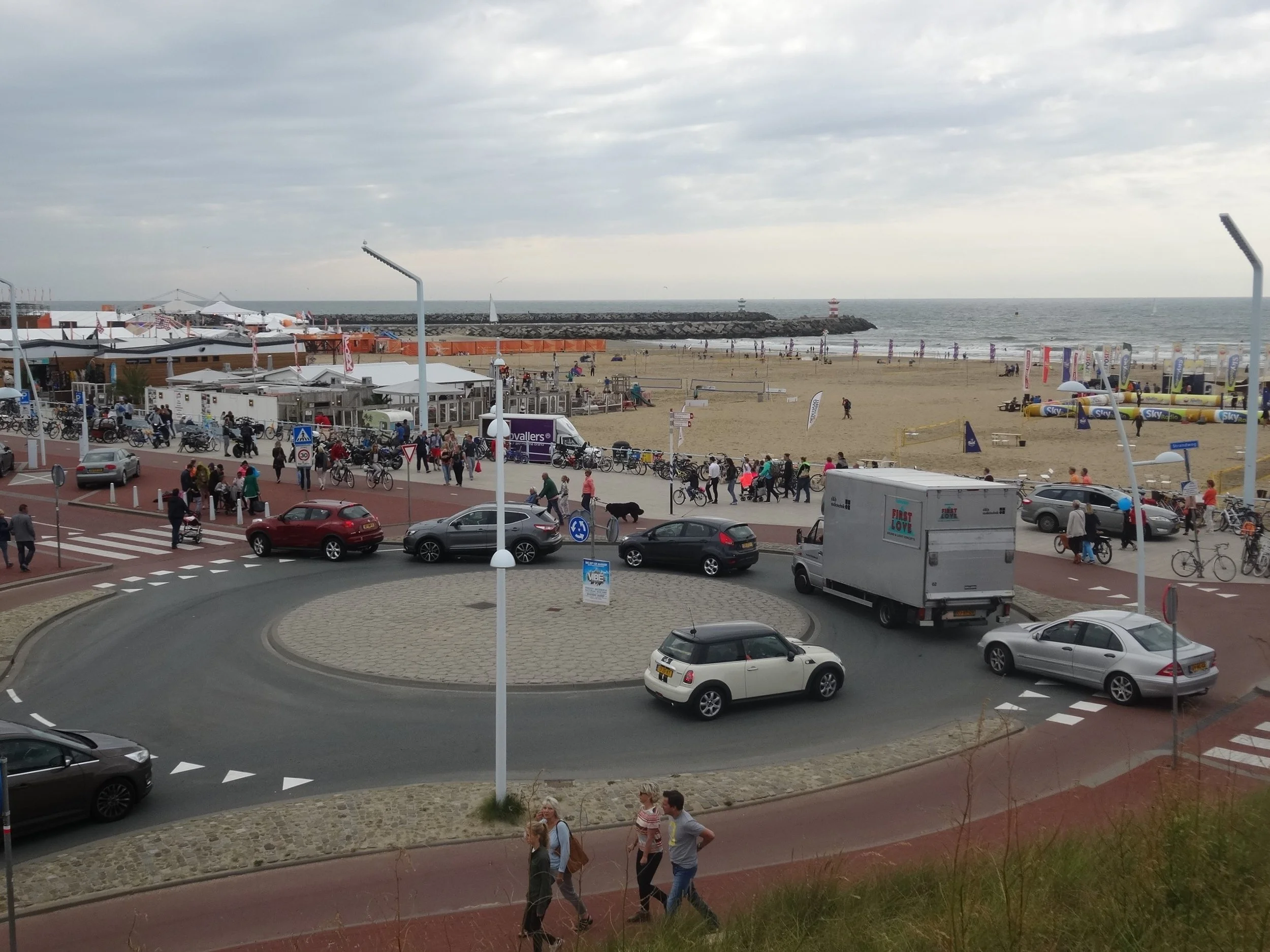
An example of a “Dutch-Style” roundabout with a protected cycle track. Image by Harry_NL
Safety Notes
The rapid proliferation of the roundabout has led to variations in design over the years. Although the safety roundabouts provide for pedestrians and bicyclists is highly touted by the city, some designs work better than others, and the city is always testing and improving.
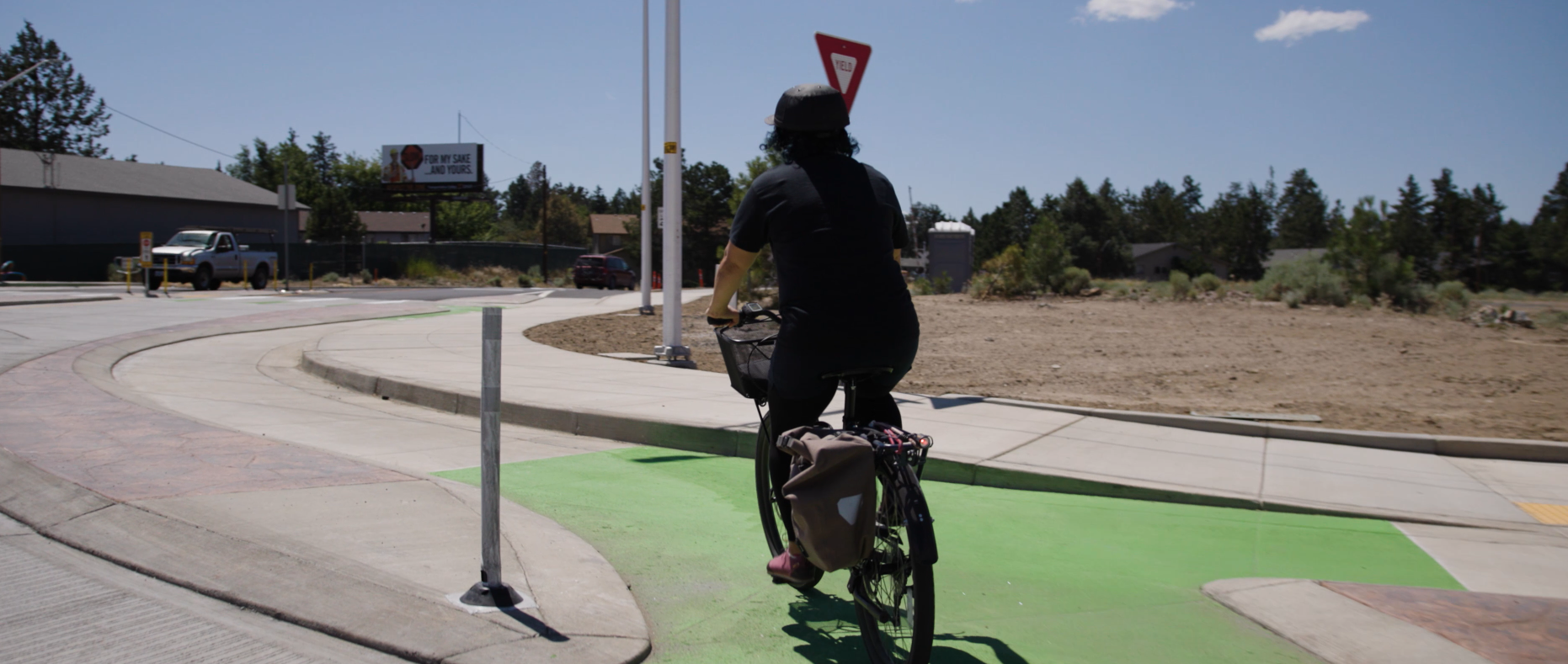
Research from the northern European cities that were the earliest adopters of the roundabout reveals that bicyclists often prefer a separated cycle track as a lower-stress alternative to traveling alongside cars and trucks. Bend recently adopted that configuration at SE Wilson Avenue and 9th Street. However, the track's sharp angle makes it difficult for bicyclists to see vehicles. Therefore, many opt to use the vehicle travel lane rather than the cycle track.
Another design consideration includes slowing vehicle speeds, as drivers are much more likely to yield to pedestrians at low speeds. Strategies that Bend has implemented to force vehicles to slow down include raised pedestrian crossings and chicanes, which are the curves at vehicle entrance and exit lanes. Additionally, multilane roundabouts are much more difficult to navigate as a pedestrian or bicyclist, as drivers may not be able to see someone crossing if their vehicle is in the innermost lane. Fortunately, some Bend councilors have recognized this critical flaw with multilane roundabouts, and are pushing for the consideration of alternatives, such as traffic lights, at intersections when both a high level of vehicle traffic and pedestrian traffic is expected.
Any roundabout design can present real obstacles for those who are blind or low-vision. Unlike traditional intersections, pedestrian crossings in roundabouts rely fully on drivers to see and yield to pedestrians. For those with visual impairments, it can make for truly vulnerable crossings. To make roundabouts more accessible, the city is creating 3D models of its roundabouts. These tactile wayfinding models will help visually impaired individuals navigate Bend’s roundabouts. However, they will not solve the issue of pedestrian reliance on vehicles to yield at crossings, so it is important that Bend continues to implement design features that make our streets safer for everyone.
Planning for the Future
Multiple efforts are underway to ensure that street and engineering standards lead to safe streets for all. The Bend Metropolitan Planning Organization is updating its Transportation Safety Action Plan, which determines both short-term and long-term projects and actions to make transportation safer for all users. The safety strategies and performance measures currently being developed will be available for feedback in the fall. Additionally, the City of Bend is beginning the process of updating the city’s Transportation Standards in July 2026, with an open house slated for fall 2026.
Think about the ways Bend’s streets and intersections work for you, and consider the ways these intersections work for others, traveling differently, and with different needs. If you were going to bike through, how would you navigate a roundabout? If you’re navigating a roundabout in a car, would raised crossings make you more likely to yield to cyclists? If you were a vision-impaired pedestrian, are there certain routes you would avoid taking because they are stressful or dangerous? As the city updates its road and roundabout standards, all of the feedback they collect will help create a transportation system in Bend that works for everyone. We’re all in these roundabouts together.
For Further Reading
For further reading on road capacity and induced demand, see: Kent Hymel’s “If you build it, they will drive: Measuring induced demand for vehicle travel in urban areas.”
For further reading on “Dutch-Style” roundabouts, see this article from the BBC.
To learn more about Bend’s effort to improve roundabout accessibility for individuals who are visually impaired, check out this article from the Source.
And, just for fun, here’s a helpful piece from The Onion: Every Driver in Roundabout Is Just Winging It.
Sources
Bend Bikes. “Protected roundabouts.” Accessed June 2, 2026. https://bendbikes.org/resources/bike-infrastructure-in-bend/protected-roundabouts/
Brooks Resources Corporation. “Portfolio.” Accessed June 2, 2026. https://brooksresources.com/communitytype/featured/
Central Oregon Daily News Staff. “Bend launches yearlong effort to reshape how people move around the city.” January 28, 2026. https://www.centraloregondaily.com/news/local/bend-transportation-standards-roundabouts-bike-lanes/article_eb183db6-88ad-4203-af36-9e1c85f7696d.html
City of Bend. “Roundabouts -a Safer Intersection Design.” Accessed June 2, 2026. https://bendoregon.gov/departments/public-works/transportation-mobility/traffic-engineering/roundabouts-a-safer-intersection-design/
City of Bend. “Roundabout Evaluation and Design Guidelines.” April 2010. https://bendoregon.gov/wp-content/uploads/2025/12/Bend_Roundabout_Evaluation_and_Design_Guidelines.pdf
City of Bend. “15th and Ferguson Roundabout Project.” Accessed June 8, 2026. https://bendoregon.gov/construction-projects/ferguson-15th-roundabout/
Fortner, Jillian. “Bend marks a quarter-century since its first roundabout; now there’s over 50, with more to come around C.O.” February 21, 2024. https://ktvz.com/news/local-news/2024/02/21/bend-marks-a-quarter-century-since-its-first-roundabout-now-theres-over-50-with-more-to-come-around-c-o/
Franke, Clayton. “New Roundabouts and Traffic Signals Slated for Midtown Bend.” June 5, 2026. https://www.bendsource.com/news/localnews/new-roundabouts-and-traffic-signals-slated-for-midtown-bend/
Gallogly, Pricilla. “Exploring the Benefits of Roundabouts vs. Traditional Intersections.” August 14, 2019. https://waengineering.com/2019/08/roundabouts/
Hutchins, Holly. “The History and Future of Bend’s Roundabouts.” May 12, 2022. https://bendmagazine.com/the-history-and-future-of-bends-roundabouts/
Poudel, Niranjan and Patrick A. Singleton. “Bicycle safety at roundabouts: a systematic literature review.” January 25, 2026. https://doi.org/10.1080/01441647.2021.1877207