Water Waste by Design

Photo: Kim Brannock
Across the high desert of Central Oregon, precious water resources are wasted at a startling scale: irrigation districts deliver nearly twice the water local crops require; water is applied to weeds and lands not currently practicing agriculture; porous canals lose up to half the water diverted from the river.
The impacts of entrenched water waste affect every community, economy, and ecosystem in the region. Modern water management has impaired treaty-reserved fishing rights throughout the homewaters of the Confederated Tribes of Warm Springs. The most productive agricultural lands in the region receive the least amount of water and endure the most unreliable access to irrigation. Growing cities and towns face mounting demands for reliable water and uncertain means for securing it. And native fish and wildlife are threatened by low flows and the dewatering of our rivers.
It sounds like something has gone very wrong. But in many ways, Central Oregon’s water management system is actually designed to create waste.
In the Deschutes Basin, the doctrine of prior appropriation, Central Oregon’s unique volcanic geology, population growth, urbanization, and land use change have converged to result in some of the most egregious examples of water waste in the American West. Simply put, senior irrigation districts in the Deschutes Basin are delivering too much water—often to nonproductive lands—with outdated, highly inefficient technology and infrastructure.
Today, concerns related to water scarcity are real. The Deschutes Basin experiences median annual water shortages of 135,000 acre-feet—worsening to 350,000 acre-feet during dry years and projected to deepen with ongoing climate change and prolonged droughts.
For Central Oregon’s livability, it is time to take the issue of water waste in irrigation districts head on and collectively chart a better water future for our rivers, farms, and cities. Without action, river-dependent ecosystems will collapse, our most productive agricultural communities will fall, and the fight for drinking water will reach tensions not seen before in our region. Luckily, solutions exist for improving irrigation efficiency, reducing unnecessary water waste, and improving how we share water throughout the Deschutes Basin.
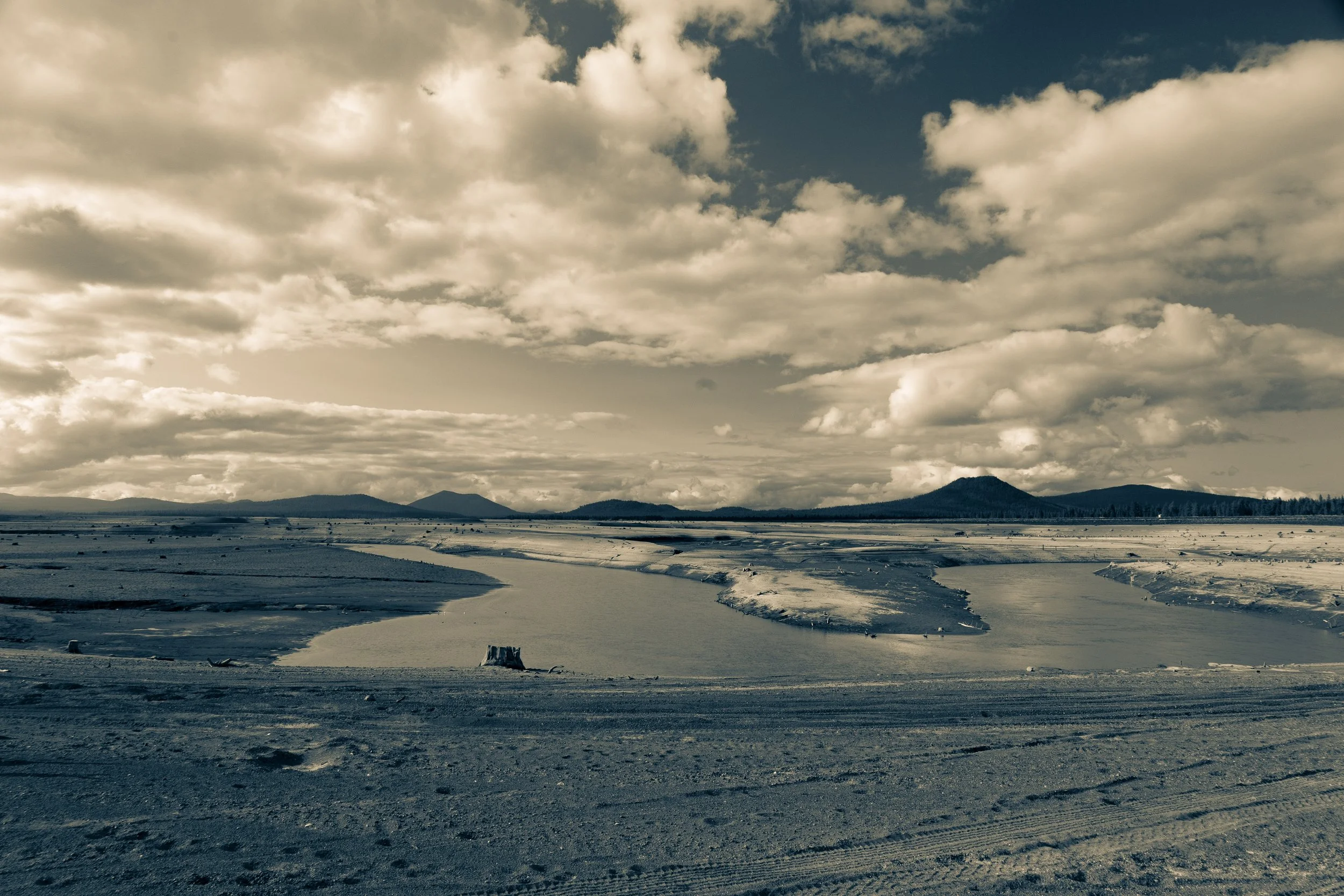
Wickiup Reservoir near La Pine is the main water source for Jefferson County farmers and can hold approximately 200,000 acre-feet of water. During the late summer of 2020, the Deschutes River was observed flowing through a nearly empty reservoir. Photo: Kim Brannock
Understanding Water Waste
Generally, “water waste” can be described using two primary definitions—physical waste and legal waste.
Physical waste: The amount of water diverted from a river that is not consumptively used by a crop.
Legal waste: The amount of water diverted from a river that is in excess of the amount required for the relevant beneficial use.
In the context of agriculture, legal waste can be divided into three categories:
Excessive use: when a water right holder uses more water than allowed under their water right’s “rate” and “duty.” Example: a water right allows for the use of 3 acre-feet of water per acre, but 5 acre-feet of water per acre is applied.
Unnecessary use: when a water right holder uses more water than is needed to grow a crop. Example: 5 acre-feet of water is applied to a crop that only needs 3 acre-feet of water.
Non-beneficial use: when a water right holder applies water in a way that is so excessive or wasteful that it is not considered beneficial. Example: irrigation water is applied to cheatgrass or other weeds.
In the Deschutes Basin, excessive use is of least concern since the region has some of the largest water rights in the West—the result of a 1930s court decree that granted large volumes of additional water to some irrigation districts. The decreed water essentially makes excessive use legal in the Basin.
While excessive use beyond the rate and duty of a water right may be less common, unnecessary and non-beneficial use are rampant. On-the-ground examples of these types of waste are below, paired with facts or quotes from local irrigators that describe the daily realities of unnecessary and non-beneficial use:
-
“I know many people that water weeds just to prove it is green in order to avoid losing future water rights.”
-
“I have seen flood irrigation in neighboring pastures that is so excessive, marsh grasses compete with forage. I see pivots and wheel lines watering 24/7 and frequently spilling over onto the road.”
-
“In August and September, we were flooding and wasting water out to BLM—again COID knew about it and did nothing. The entire neighborhood called repeatedly and got crickets.”
* Note: All irrigator quotes come from anonymous surveys and interviews with Central Oregon Irrigation District patrons. Anonymity protects respondents who wish to speak candidly about district practices and their unique experiences.
MORE POSTS IN OUR WATER WASTE SERIES